
The 2027 Honda CBR1000RR-R Fireblade SP Engine: MotoGP Architecture in a Road Bike
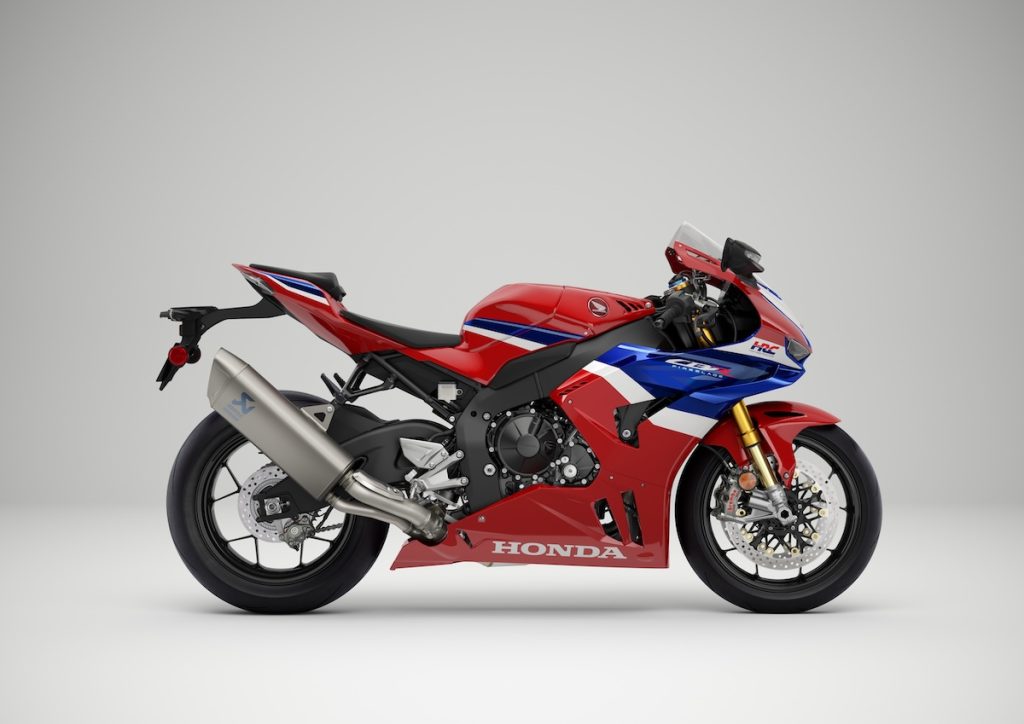
The engine is the story. Honda’s 999.9cc DOHC inline four runs an 81.0mm bore and 48.5mm stroke — the same oversquare dimensions as the RC213V MotoGP machine — with a 13.6:1 compression ratio and a semi-cam gear train. Diamond Like Carbon (DLC) coating on the cam lobes cuts valvetrain friction by 35% compared to uncoated lobes; the same DLC technology appears on the RC213V-S MotoGP replica. Ti-64A titanium connecting rods (a Honda-developed alloy) reduce weight by 50% compared to chrome-moly equivalents, and the big-end surfaces are DLC treated as well.
The two-motor throttle-by-wire system is the most sophisticated TBW Honda has put in a production road bike. Cylinders 1 and 2 open first through smaller throttle openings, allowing fine output control and intentional crank rotation fluctuations for smooth low-rpm feel; all four throttle valves open together as revs climb. On deceleration with the throttle fully closed, cylinders 3 and 4 open with the exhaust valve closed to amplify engine braking — while cylinders 1 and 2 stay closed, ready to respond cleanly on the next acceleration. Ram-air intake aperture is equivalent to the RC213V; throttle bodies run 52mm diameter.
The Akrapovič titanium exhaust — with oval cross-section downpipes — exits on the right side. The rear of the engine block doubles as the upper shock mount. The engine starts via clutch main shaft rotation rather than crankshaft, keeping the package compact. Redline cold-start protection moves the limit to 8,000 rpm until coolant reaches operating temperature, then climbs to just over 14,000 rpm.
Öhlins, Brembo, and the 2027 Honda CBR1000RR-R Fireblade SP Suspension Package
The suspension spec is third-generation Öhlins: a 43mm S-EC3.0 (SV) NPX inverted fork using an internal spool-valve structure to optimize ride quality and turning stability through the suspension stroke, and an Öhlins TTX36 S-EC3.0 (SV) rear shock. The key feature for anyone running this bike on track is the Öhlins OBTi — Objective Based Tuning interface — which allows front and rear suspension adjustment independently from the default settings, with three storable modes that can be switched on the fly while riding. Weather, tire wear, fuel load — you can configure for all three and switch without stopping. A spring-preload guide via the TFT recommends settings for rider weight.
Braking comes from Brembo Stylema R four-piston radial-mount calipers — the same Brembo unit used on the RC213V-S — gripping 330mm×5mm discs via a Brembo master cylinder and brake lever. Three ABS modes: Standard (road, high brake force with less pitching), Track (circuit speeds, no rear-lift suppression), Race (rear ABS off entirely). Wheelbase is 57.2 inches; rake and trail are 24.1° and 4.0 inches (102mm); curb weight 445 lb with a 53/47 front/rear weight distribution.
Aerodynamics: How the 2027 Honda CBR1000RR-R Fireblade SP Bodywork Works
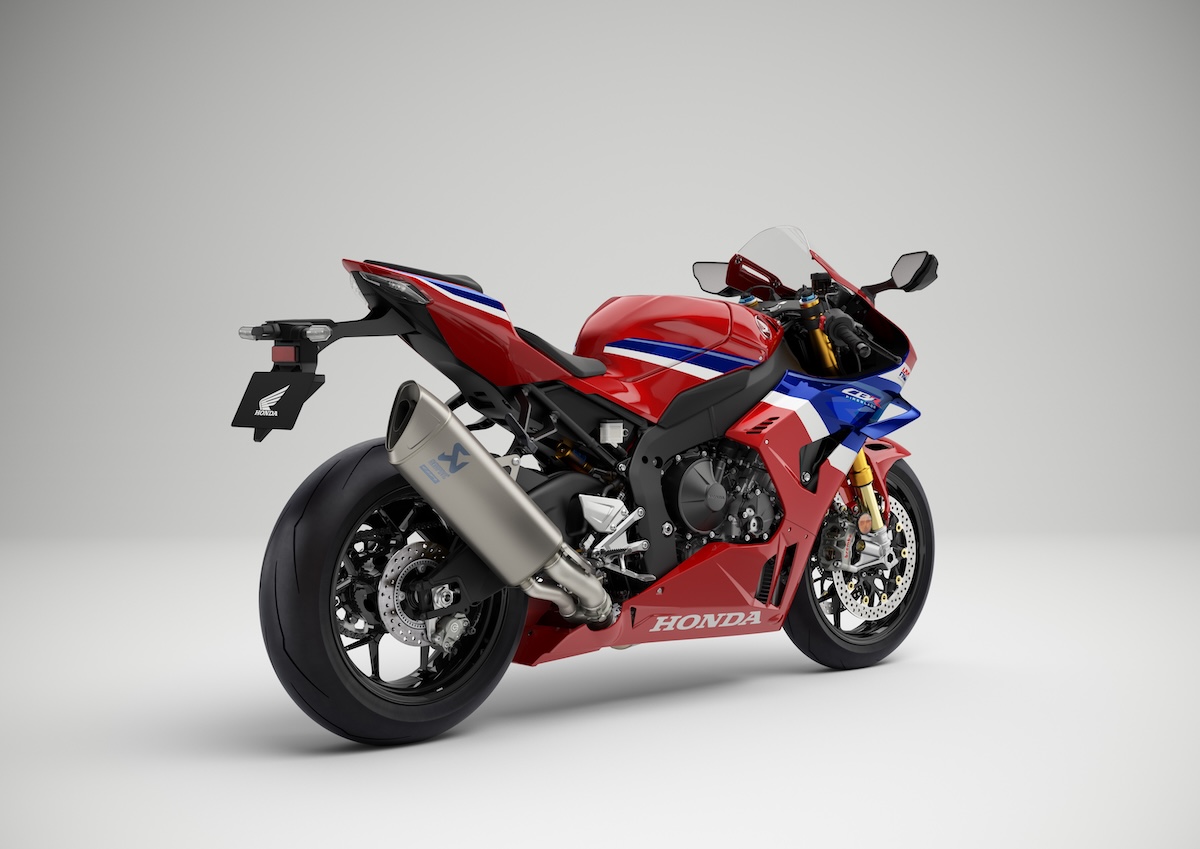
The fairing is a functional aerodynamic package, not a styling exercise. The forward-set winglets in the fairing midsection generate downforce — suppressing wheelies under acceleration and enhancing stability at corner entry — while reducing yaw moment through corners by 10%. A convex surface on each side of the front fender redirects airflow away from the front wheel. The lower fairing extends close to the rear tire with an aerodynamic step to minimize tire-adjacent airflow. The rear hugger is cut to vent air from under the swingarm, reducing rear lift.
Electronics Suite on the 2027 Honda CBR1000RR-R Fireblade SP
Electronics run through a Bosch six-axis IMU. Power levels 1–5 (1 = maximum output); Engine Brake levels 1–3; Wheelie Control levels 1–3 plus off. Wheelie Control pulls IMU pitch angle alongside wheel speed sensors to manage lift without sacrificing forward drive. Start Mode holds rpm at selectable set points (6k, 7k, 8k, 9k) for race starts — the rider focuses on lights and clutch release. Three-level quickshifter with short fuel cut time and smooth torque recovery. Honda Electronic Steering Damper (HESD) — through-rod design, three control levels, mounted at the base of the steering stem — responds to wheel speed sensors and IMU input. Full-color 5-inch TFT, Honda Smart Key.
2027 Honda CBR1000RR-R Fireblade SP Price and Availability
At $28,999, the 2027 Honda CBR1000RR-R Fireblade SP occupies the top of Honda’s street-legal supersport range and one of the most technically dense production chassis available at any price. The OBTi suspension system alone represents a meaningful differentiator — the ability to configure front and rear damping independently across three storable presets and switch between them while moving is genuinely useful on a bike that sees both road and track use. For the rider who runs it in both contexts, the 2027 Honda CBR1000RR-R Fireblade SP is set up to handle both without compromise.

About The Author
Discover more from SportBikes Inc Magazine
Subscribe to get the latest posts sent to your email.
1 thought on “2027 Honda CBR1000RR-R Fireblade SP: MotoGP Engineering at $28,999”