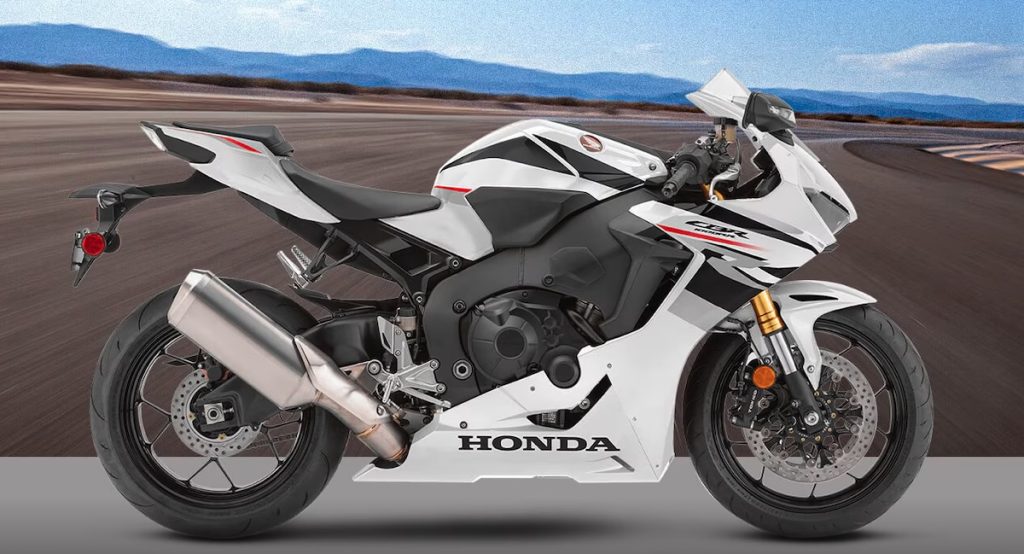

Honda confirms the 2027 Honda CBR1000RR in Pearl White at $17,099, with the ABS variant at $17,399 and availability set for July 2026. The 2027 Honda CBR1000RR has been the accessible litre bike in Honda’s supersport range since its U.S. debut in 2004 — the platform built around Total Control rather than outright track specification, and the one that more riders actually put miles on. The 2027 continues that mission with DLC engine technology, a Showa BPF front end, BFRC rear shock, and HESD steering damper.
What “Total Control” Means on the 2027 Honda CBR1000RR
Honda’s Total Control philosophy traces to the CBR900RR of the early ’90s — the idea that the ideal connection between rider and machine requires an optimal balance of engine performance, light weight, and nimble handling rather than maximizing any single parameter. The CBR1000RR has carried that forward through every generation: a chassis built around mass centralization, an engine tuned for accessible power delivery across the rpm range, and an electronics package calibrated for real-world confidence rather than pure lap-time aggression. The 2027 is the current expression of that lineage.
The 2027 Honda CBR1000RR Engine: DLC, TBW, and Street-Ready Power
The 1,000cc DOHC inline four runs the same 76.0×55.1mm bore and stroke as the 2026 CB1000F, with a 13.0:1 compression ratio and a peak of 13,000 rpm. DLC coating on the piston rings provides superior sealing; the pistons themselves use varying wall thicknesses for the balance of high strength and low weight. Magnesium construction on the oil pan and ignition cover keeps engine weight in check. Valve lift and timing are optimized for high engine speeds, and the slash-cut intake funnels maximize top-end charge efficiency. The titanium fuel tank — manufactured via ultra-deep drawing — holds 4.3 gallons and contributes to mass centralization.
Throttle-by-wire is adapted from the RC213V-S, with a built-in accelerator position sensor for optimal response. Honda Selectable Torque Control (HSTC) reads front and rear wheel speeds and body roll angle. Wheelie control is standard. Five-level Power Selector allows on-the-fly riding mode adjustment; three-level engine brake tuning is also available. The slipper clutch uses die-cast aluminum assist cams with optimized clearance for good lever feel.
Chassis and Suspension on the 2027 Honda CBR1000RR
The aluminum frame uses varying wall thicknesses to balance weight and flex characteristics; the die-cast aluminum subframe keeps unsprung weight honest. Rake and trail are 23.4° and 3.8 inches (96mm). Front suspension is a 43mm Showa large-volume BPF (Big Piston Fork) inverted unit with 4.7 inches of travel. The rear runs a Unit Pro-Link system with a Balance Free Rear Cushion (BFRC) shock absorber and 5.4 inches of travel — Honda’s BFRC design eliminates the conventional compression valve to reduce fluid flow resistance and improve damping linearity through the stroke.
The Honda Electronic Steering Damper (HESD) adjusts damping proportionally to vehicle speed, keeping low-speed maneuverability intact while tightening response as velocity climbs. Five-Y-spoke wheels minimize rotational inertia; front braking is handled by Tokico four-piston opposed radial-mount calipers with high-friction pads. The ABS variant adds rear-lift control and lean-angle-sensitive brake force distribution — aggressive trail braking capability is part of the spec on the ABS model.
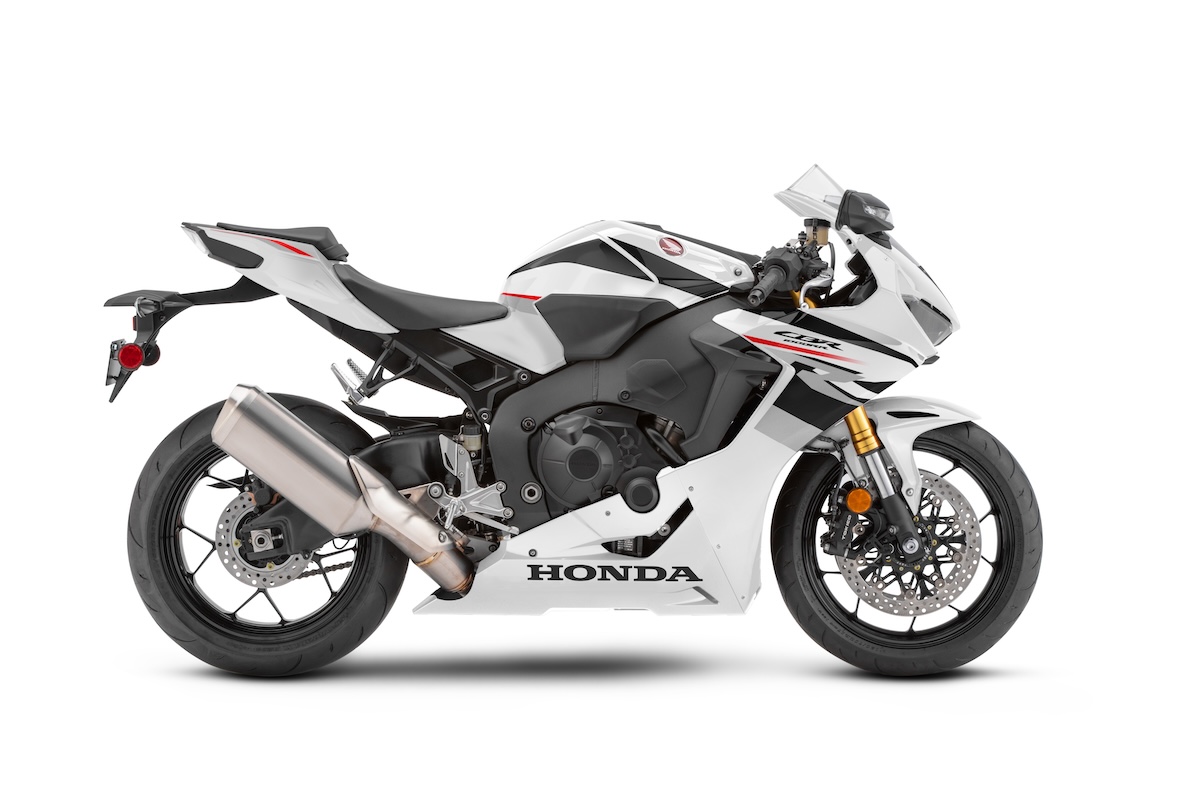
2027 Honda CBR1000RR vs. CBR1000RR ABS: Price and Availability
The standard 2027 CBR1000RR is $17,099 in Pearl White; the CBR1000RR ABS adds $300 for the front/rear ABS system with rear-lift control and cornering ABS. Both are available July 2026. The TFT instrument cluster runs Street, Circuit, and Mechanic display modes. Honda’s announcement also covered the 2027 CBR1000RR-R Fireblade SP ($28,999, August) and the new 2026 CB1000F ($10,599, May) — both covered on SportBikes Inc.
The 2027 Honda CBR1000RR sits at a practical crossroads that its stablemate, the Fireblade SP, does not occupy. At $17,099, it’s a genuinely usable street bike with a lap day in it — light, manageable at lower rpm, and set up with electronics that support confidence rather than demanding expertise. The HESD alone changes the character of the bike: a steering damper that adjusts proportionally to speed means the same chassis behaves differently at parking-lot pace versus canyon pace, without the rider touching anything.
The BFRC shock absorber in the rear is worth noting for riders who’ve experienced conventional valved shocks on previous litre bikes. The Balance Free design eliminates the compression valve, reducing internal fluid resistance and delivering more linear damping response through the stroke. It’s a measurable improvement in feel on imperfect surfaces — which is where the 2027 Honda CBR1000RR spends most of its working life relative to the Fireblade SP.

About The Author
Discover more from SportBikes Inc Magazine
Subscribe to get the latest posts sent to your email.