
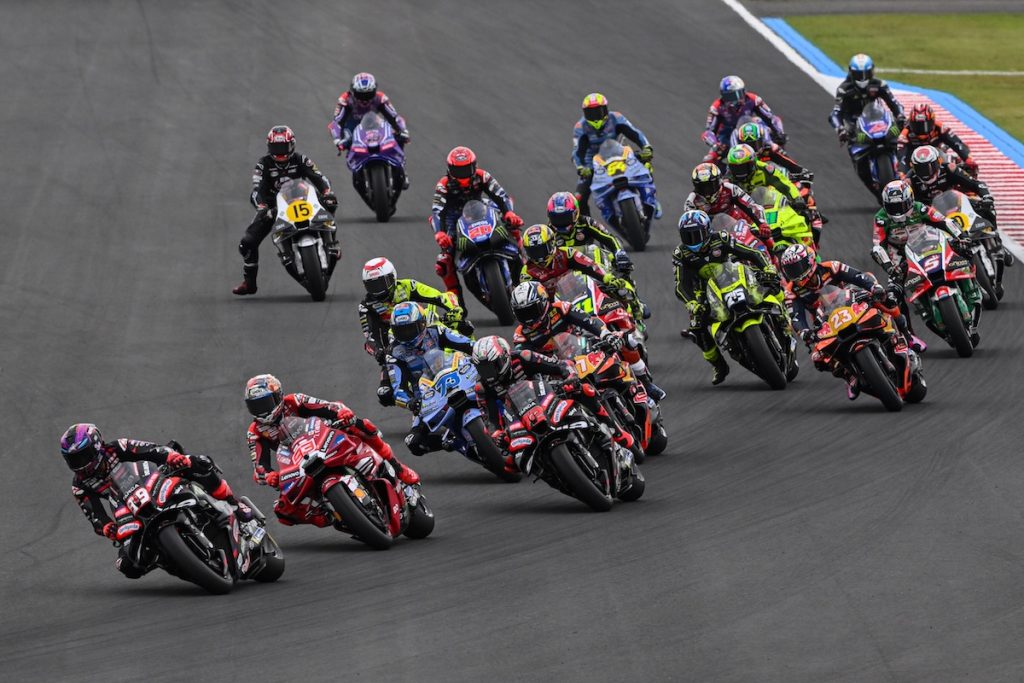

The MotoGP 2027 weekend format adds a 15-minute Sprint qualifying session on Friday, gives the Sprint its own starting grid, and takes practice time away to pay for it. The Grand Prix Commission confirmed the changes on October 7, effective for the 2027 season. MotoGP says the result is distinct grids for the Sprint and the Grand Prix at every round, where the Sprint used to start from the Grand Prix grid.
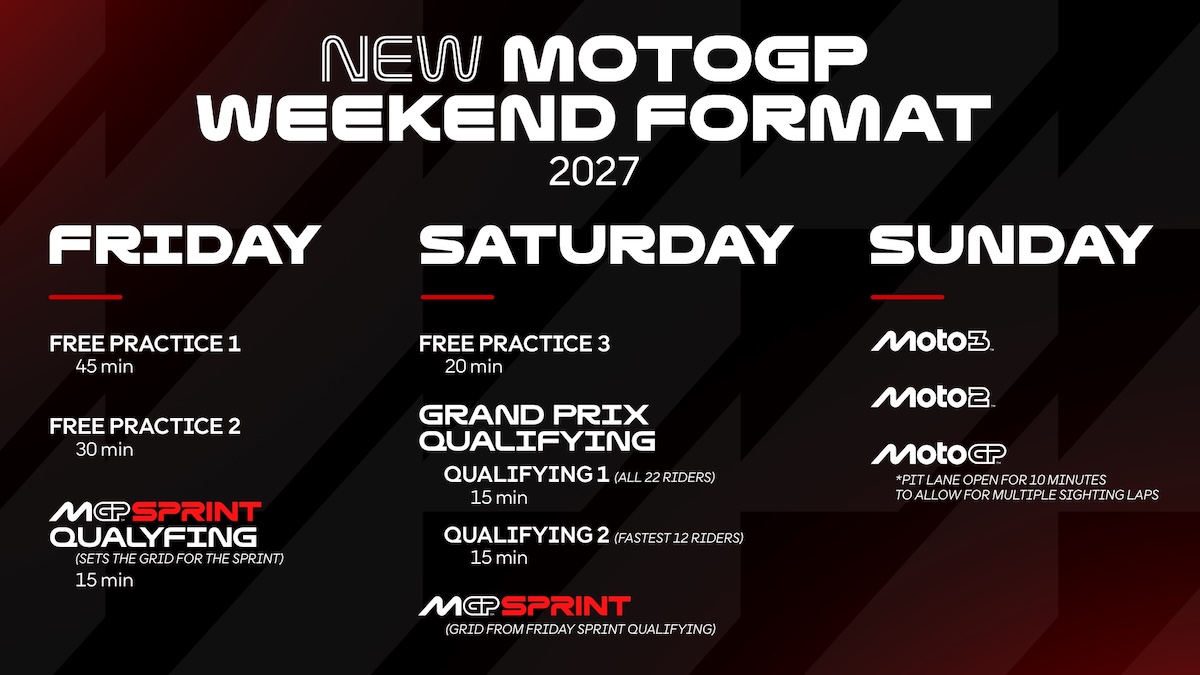
The MotoGP 2027 Weekend Format, Session by Session
Friday opens the same way it does now, with a 45-minute FP1. A 30-minute FP2 follows, then the new Sprint qualifying session, 15 minutes long and open to all riders. Its result sets the grid for Saturday’s Sprint. MotoGP says the shorter FP2 will not be timed for entry into any other session.
Saturday starts with a 20-minute FP3. Grand Prix Qualifying 1 follows, 15 minutes with every rider on track, and the top 12 move on to a 15-minute Q2 that decides pole position and the front four rows. The Sprint runs Saturday afternoon from Friday’s grid, and the Grand Prix grid, built from Q1 and Q2, waits for Sunday.
Sunday changes at both ends, according to MotoGP’s announcement. Moto3 and Moto2 now open the day. The ten-minute MotoGP Warm Up is replaced by a ten-minute pit lane opening before the Grand Prix, with room for several sighting laps. The ten minutes survive. They just move to the last thing riders do before the lights go out.
What the MotoGP 2027 Weekend Format Takes Away
The Commission is blunt about the trade. It describes the Sprint qualifying session as paid for by a reduction in practice track time. Add up Friday and the picture is clear: riders get 45 plus 30 minutes of free practice, 75 in all, before the first session that sets a grid. The Commission’s text does not say how much running the new schedule removes overall.
The bigger loss is the safety net. Today the best riders in Friday’s combined practice go straight into Q2, and everyone else fights through Q1. Under the 2027 plan Q1 takes the entire field, so nobody skips it. Our look at the San Marino weekend shows what that removes: Francesco Bagnaia sat 19th after Friday and went to Q1, while Enea Bastianini missed direct Q2 passage by 0.014 seconds.
Under today’s rules a bad Friday still leaves a route back through Q1 with a chance of Q2. The MotoGP 2027 weekend format sends everyone through Q1, so a poor Friday is no longer a separate problem from Saturday. A crash or a mistake in Sprint qualifying also leaves a rider on the back of the Sprint grid, and the Grand Prix grid still has to be earned separately.
How the MotoGP 2027 Weekend Format Changes the Pressure
Two grids mean two qualifying results to protect. Marc Marquez swept the Sprint and the Grand Prix at Aragon, as our race report covered. A sweep like that now has to survive two qualifying sessions instead of one, and a rider who is fastest on Friday afternoon has to repeat it on Saturday morning.
It also puts more weight on the Sprint, a format that arrived in 2023 and that SBI covered at its introduction as a way to give the class’s stars more airtime. A Sprint with its own qualifying has its own stakes, its own pole position and its own story, separate from Sunday’s.
What the Commission’s text leaves out matters as much. There is no word on tyre allocation for the extra session, on whether Moto2 and Moto3 change, or on Sunday start times. Tyre allocation is the detail to watch. It decides how many hot laps a rider can afford on Friday, and so how brave anyone can be in a session that now counts.
Where the MotoGP 2027 Weekend Format Goes Next
The change arrives in a season that already changes a lot. MotoGP describes 2027 as arriving with new bikes and technical regulations, and the 22-round calendar adds Buenos Aires and a street circuit in Adelaide at round 21. New machines on a new schedule put a lot of unfinished questions into 75 minutes of Friday practice.
Adelaide is the cleanest test. A first-year street layout, a bike nobody has fully figured out and a Sprint grid that gets decided before Saturday’s practice has even started would be a tough exam for any team. Whether the format makes the racing better will show up in the Sprint results. The schedule already shows where the value moves, which is to preparation.
A team used to find its answer slowly, across three days and a lot of laps. Now the grading starts after 75 minutes, and the garages that show up with the answer already in hand, from simulation, from data and from riders who learn tracks fast, will own that weekend.

About The Author