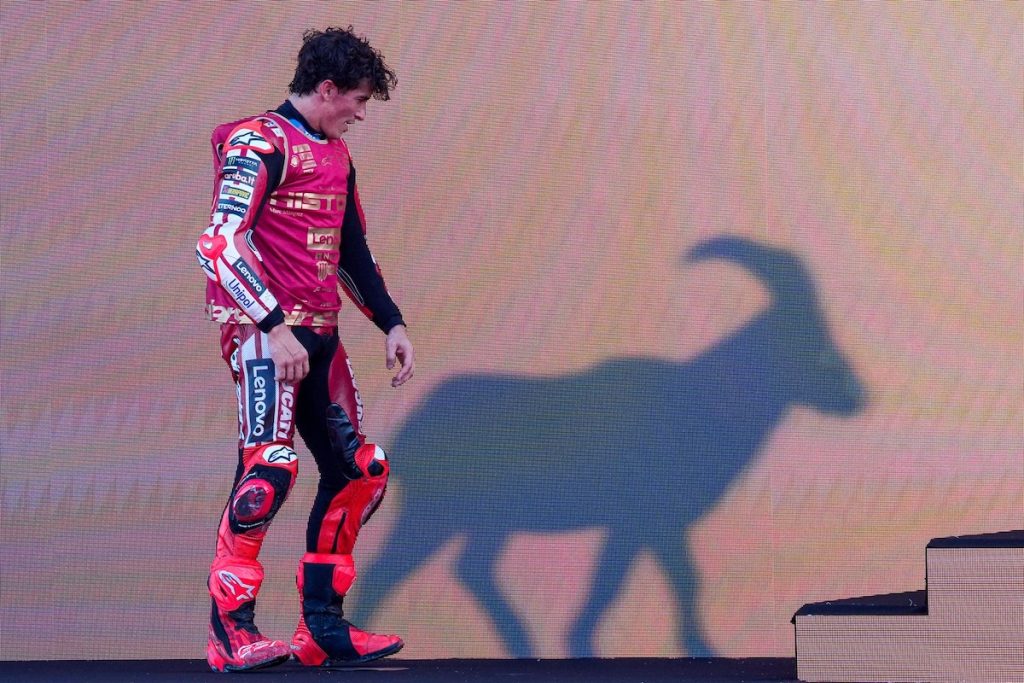

He won the championship five days ago and he had already decided to stop. The Marc Marquez retirement was settled at Motegi, weeks before Portimao, and the only person who knew was his brother.
Marquez announced it on Friday morning during FP1 at Valencia, inside the Ducati Lenovo Team box, then took questions at the circuit. He races one more time on Sunday as the reigning champion.
How the Marc Marquez Retirement Was Announced
There was no staged build-up and no farewell tour. He told the team during the first practice session of the final weekend of the season, which is about as close to the last possible moment as the calendar allows.
He said the decision dated back to Motegi and that Alex was the only person who knew. He held it deliberately, because talking about stopping would have cost him energy in a championship he was still fighting for.
Alex Marquez rode the entire second half of the season as the only person in the paddock carrying that information. The two have been team-mates, rivals and brothers across the comeback years, and whatever was said between them stayed there.
The Reasons Behind the Marc Marquez Retirement
He was direct about the physical side. He signed his Ducati contract in March expecting a straightforward season, then had another operation on his right shoulder after Le Mans, and the weakness in his arm kept progressing through the year.
Then the part that carries the most weight. He had double vision twice this season, for 48 hours after Indonesia and for 12 hours after Le Mans. He controlled both episodes, and he connects them directly to why he rode with more margin and crashed less across the back half of the year.
He described the problem as fear and was careful about which kind. Not fear of the bikes or the speed, but of an injury already present. A rider who spent a career being told he took too much risk has stopped because he started calculating it.
He took the contract question head-on as well. He signed with Ducati in March expecting to continue, and said the team understood once the situation changed. That is not a small thing, because a rider walking away mid-contract usually produces a different kind of story.
Nothing about the Marc Marquez retirement reads as a decision forced from outside. He had a contract, a competitive bike and a championship in hand. The pressure came from inside his own body, and he is the one who called it.
The Marc Marquez retirement therefore reads differently from most. He is not slow, he is not out of a seat, and he is not coming off a bad year. He is the reigning world champion walking away at 33.
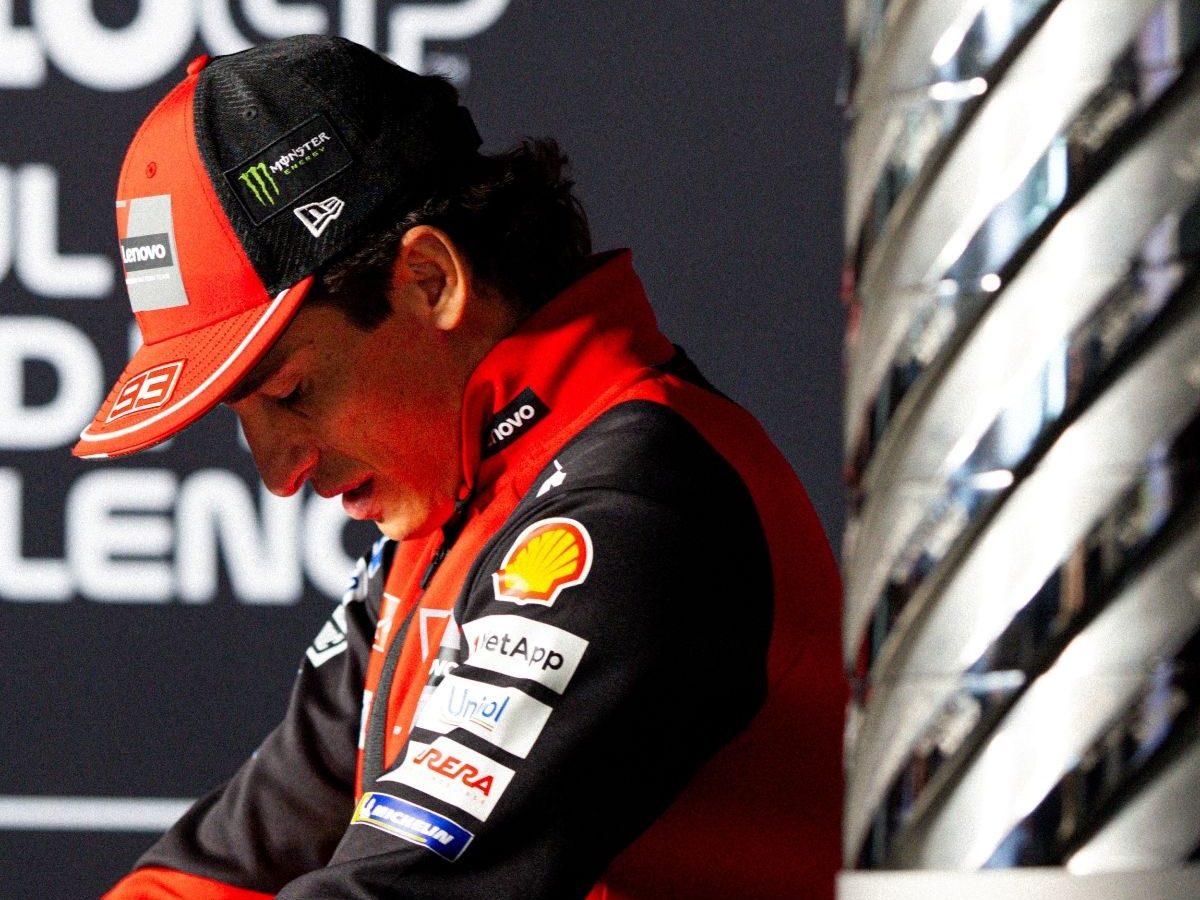
Where the Marc Marquez Retirement Leaves the Record Books
The Marc Marquez retirement arrives with his count level at eight titles in the top class with Giacomo Agostini, which is the record the announcement names. Agostini still leads on world championships across all classes, 15 to 10, because his total includes titles in a class that no longer exists.
Marquez reached eight the hard way. The first came in 2013 as a MotoGP rookie. The last five years of his career took in a broken arm, repeated surgery, a long spell out of contention and a move away from Honda before he won anything again.
The 2026 season was the proof. He swept Aragon, scored 368 points from Hungary onward for a 128-point advantage over everyone else on the grid, and turned seven of his eight Grand Prix podiums into wins on the way to the title at Portimao.
What the Marc Marquez Retirement Does to Valencia
Sunday was already carrying more than a normal finale. It closes the 1000cc era before MotoGP drops to 850cc in 2027. It ends twelve seasons between Brad Binder and KTM. Now it is also the last race of an eight-time champion.
Two championships are still open underneath all of that. Izan Guevara needs a win, or to outscore Manuel Gonzalez by five, to take Moto2. Aprilia leads Ducati by nine points in the constructors standings going into the weekend.
The timing of the Marc Marquez retirement is what makes Sunday unusual. A rider leaving at the end of a thin season gets a quiet exit. A champion announcing it in FP1 of the final round turns the entire weekend into something else.
A finale with nothing at stake is a parade. This one has two titles live, three endings and a rule change waiting on the other side of it.
The Career the Marc Marquez Retirement Closes
He started Grand Prix racing in 2008 and reached MotoGP in 2013, taking the title in his first season. Honda carried him through the dominant years. Ducati Lenovo carried him through the comeback.
What he will be remembered for is not the count. It is a riding style built on saving front-end crashes nobody else could save, and a decade of rivals being asked to explain why they could not ride like that.
MotoGP has been losing its reference points steadily. Aleix Espargaro stepped away in 2024 after a long run as Aprilia’s anchor. A champion going out while still winning is a different kind of exit, and a harder one for the championship to absorb.
He put the ending plainly at the press conference: “I gave everything but it’s time to stop.”
What Comes After the Marc Marquez Retirement
His Ducati Lenovo seat opens for 2027.
The larger thing is the timing. MotoGP moves to 850cc engines in 2027, Moto2 moves to a new 798cc Triumph triple that forces every team onto a new chassis, and both classes reset their technical baselines in the same winter.
So 2027 begins with new engine rules, new chassis in the support class and no eight-time champion on the grid. Grids reset slowly and reputations reset faster, and the first rider to win a race next year will do it without the man everyone has measured themselves against since 2013.

About The Author